
How Precision Grinding Services Improve Tight-Tolerance Components
Quick Summary
Grinding refines parts that are already close to spec, removing tiny amounts of material to hit tolerances that cutting or milling can’t reach on their own. Heat-treated parts often need this step, since hardening introduces small dimensional shifts that only grinding can correct. Surface, cylindrical, and Blanchard grinding each solve a different problem, but all of them turn a functional part into a precise one. Keeping grinding alongside earlier processes, such as cutting and heat treating, in a single facility reduces handoffs and dimensional drift between steps.
Some parts need more than a clean cut to be ready for use. A shaft that has to fit into a bearing with almost no clearance, a die that has to hold a flat surface within a few thousandths, a hardened tool-steel component that can’t be machined further once heat-treated. These are the parts that end up on a grinder, because it’s often the only process fine enough to get the final dimension right.
Precision grinding services use an abrasive wheel to remove very small amounts of material, refining a surface or dimension that’s already close to spec but not quite there. It sounds like a small detail in a larger manufacturing process, and in terms of material removed, it usually is. The difference it makes to how a part performs is not small at all.
What Precision Grinding Services Do
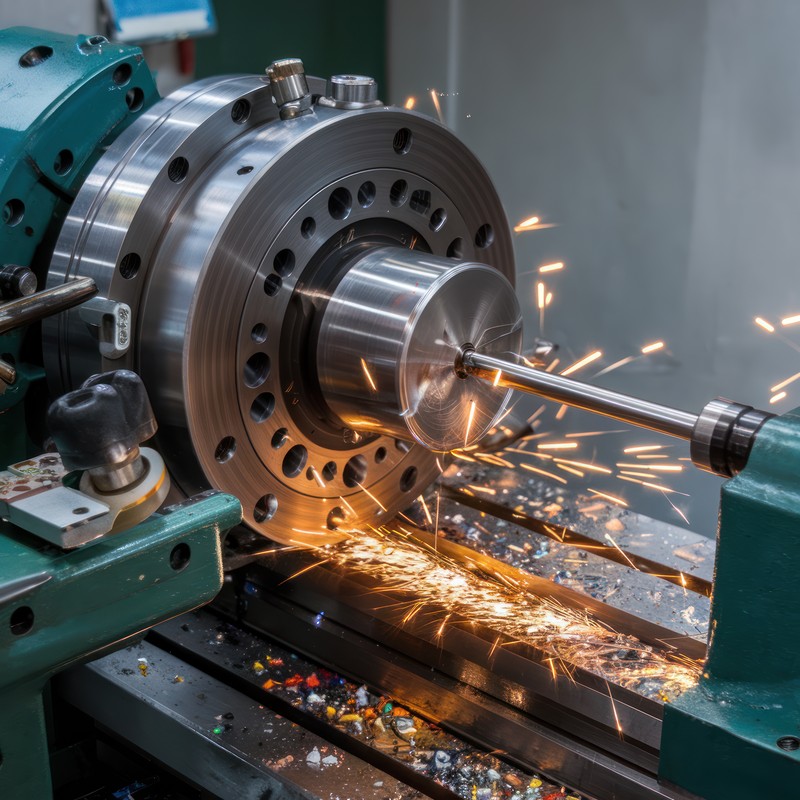
Grinding works differently than cutting or milling. Instead of a single-point tool that removes material in chips, a grinding wheel made of thousands of abrasive particles skims across the surface. The wheel can remove material in thousandths of an inch. That level of control is what makes grinding useful for final finishing work, especially on parts that have already been hardened and can’t be shaped with standard cutting tools anymore.
A few common types of grinding show up across industrial work:
- Surface grinding: Flattens or finishes flat surfaces, often used on plates, dies, and fixture components that require a consistent, level face.
- Cylindrical grinding: Refines the outer diameter of round parts such as shafts and rollers, maintaining tight tolerances for diameter and roundness.
- Blanchard grinding: Handles large flat surfaces efficiently; often used as a first pass before finer finishing work.
Each type solves a slightly different problem, but the goal across all of them stays the same. Take a part that’s already close to its final dimension and refine it until it matches the drawing exactly.
Why Tight Tolerances Depend on Precision Surface Grinding Services
Tolerances get tighter for a reason. A part that needs to seal against another surface, rotate without wobble, or fit into an assembly with no play left has almost no room for error. Precision surface grinding services are often what close the final gap between a part that’s close enough and one that meets spec.
This matters most on parts that have been heat treated. Hardening a part changes its structure and can cause slight warping or a dimensional shift. A part machined to spec before heat treatment might come out of the furnace slightly out of tolerance. Grinding after heat treatment corrects this without needing to reshape the whole part. It’s a targeted fix rather than a full rework.
Grinding also plays a role earlier in a part’s life, before heat treatment even comes into play. Parts that start as sheared or cut stock sometimes need a finishing pass to remove roughness left by the initial cut, especially on surfaces that will later mate with another component. Getting that surface right early on saves time and rework further down the production line.
Where Grinding Fits Into the Bigger Picture
Grinding rarely stands alone as the only process a part goes through. A shaft might be turned to rough dimensions, heat-treated for hardness, then finished on a cylindrical grinder to meet its final tolerance. A die might be shaped by milling and drilling, then flattened on a surface grinder before going into production. In both cases, grinding is the last step that turns a functional part into a precise one.
This is part of why precision grinding services work best when they’re available alongside the earlier processes that shape a part. A part moving between separate shops for cutting, heat treating, and grinding picks up delays and risk at every handoff.
Keeping these processes under one roof means fewer surprises when a part reaches its final finishing stage, and fewer chances for a dimension to drift between steps.
Common Applications for Industrial Precision Grinding
Industrial precision grinding shows up across a wide range of parts and industries. A few examples worth knowing:
- Tooling and dies: Punches, dies, and fixture components that need flat, consistent surfaces to function correctly over repeated use.
- Shafts and pins: Round components that need a precise diameter to fit into bearings, bushings, or housings without excess play.
- Hardened components: Parts that have undergone heat treatment and require the final dimensional correction only grinding can provide.
- Wear surfaces: Any flat or round surface that comes into repeated contact with another part benefits from the smoother, more consistent finish grinding provides.
Materials commonly ground include tool steel, stainless steel, and other hardened alloys. These materials are chosen for their strength and wear resistance during use.
Signs a Part Might Need Grinding
Not every part needs a grinding pass, but certain signs point toward it. A tolerance call-out tighter than what standard cutting or milling can reliably hold is one signal. A part specified as hardened or heat-treated is another, since that process almost always introduces some degree of dimensional shift that needs correcting afterward.
A surface finish requirement (listed on a drawing as a specific roughness value) also points toward grinding as the process that gets a part there. Engineers reviewing a design early on can flag these signs before a part reaches production. This approach helps save time compared to discovering mid-run that a part needs an extra finishing step that wasn’t planned for.
What Sets a Reliable Grinding Partner Apart
A shop offering grinding as part of its capabilities should be able to answer a few practical questions clearly. Does grinding happen in-house, or does the part need to travel to a separate vendor for that final step? Can the shop consistently hold the tolerance called out on the drawing, run after run, not just on a sample part? Is there a quality process in place to catch dimensional drift before a full batch ships?
Gauer Metal Products, Inc. has been running precision manufacturing processes, including Blanchard, surface, and cylindrical grinding, in-house for decades, alongside cutting, milling, and heat treating. That combination keeps parts moving through fewer hands and fewer opportunities for something to go wrong between steps.
Getting Tight-Tolerance Parts Right From Start to Finish
Grinding isn’t the flashiest part of a manufacturing process, but for tight-tolerance components, it’s often the step that determines whether a part actually works as intended. Knowing when a part needs it and having a shop capable of handling it without extra handoffs makes the difference between a part that’s close and a part that’s correct.
Contact the team at Gauer Metal Products, Inc. today if your project involves parts with tight tolerances or specific finish requirements.
FAQs
What is precision grinding used for?
Grinding removes very small amounts of material to refine a part’s surface or dimension. It’s typically the final step for parts that need to hit tight tolerances after cutting, milling, or heat treatment.
Why do heat-treated parts often need grinding afterward?
Hardening a part changes its structure and can cause slight warping. Grinding corrects that dimensional shift without reshaping the whole part, so it stays a targeted fix rather than a full rework.
What’s the difference between surface and cylindrical grinding?
Surface grinding flattens or finishes a flat surface, like a plate or die. Cylindrical grinding refines the outside diameter of round parts, holding tight tolerances on diameter and roundness.
How do you know if a part needs grinding?
A tolerance tighter than standard cutting or milling can hold, a heat-treated specification, or a surface finish requirement on the drawing all point toward grinding as the final finishing step needed.
Why does it help to have grinding in-house alongside other processes?
Parts moving between separate shops for cutting, heat treating, and grinding pick up delays and risk at every handoff. Keeping these steps under one roof reduces surprises during final finishing.