Sheet Metal Punching Vs. Waterjet Cutting For Industrial Parts
Quick Summary
Punching and waterjet cutting solve different problems on the shop floor. Punching wins on speed and cost once a production run reaches volume, while waterjet handles thick plate and complex shapes without heat distortion. Material thickness, tolerance needs, and part quantity determine which process fits a given job, and some projects benefit from combining both.
Selecting a cutting process for industrial metal parts comes down to more than personal preference. Every job has its own thickness, tolerance, and volume requirements.
Those details point toward one method over another. Two of the most common options in the industry are punching and waterjet cutting. Sheet metal punching services often come up first because of how widely they’re used across manufacturing. Let’s break down how each process works, covering where each one shines and what to think about before committing to either.
What Sheet Metal Punching Services Involve
Punching uses a machine press to force a hardened tool, called a punch, through a metal sheet and into a matching die. The result is a clean hole or shape cut in a single stroke.
It’s a mechanical process and relies on force and precision tooling rather than heat or a liquid medium. Manufacturers turn to punching when they need repeatable shapes cut quickly across a run of parts. Once the tooling is set, punching machines can produce hundreds or thousands of identical pieces with very little variation.
This makes the process a natural fit for production runs where consistency matters as much as speed. Punching also pairs well with other cold-forming steps.
Parts often move from a punch press into forming or bending equipment to complete a final shape. At Gauer Metal Products, our metal punching and stamping solutions are typically part of a larger fabrication sequence.
Where Waterjet Cutting Fits In
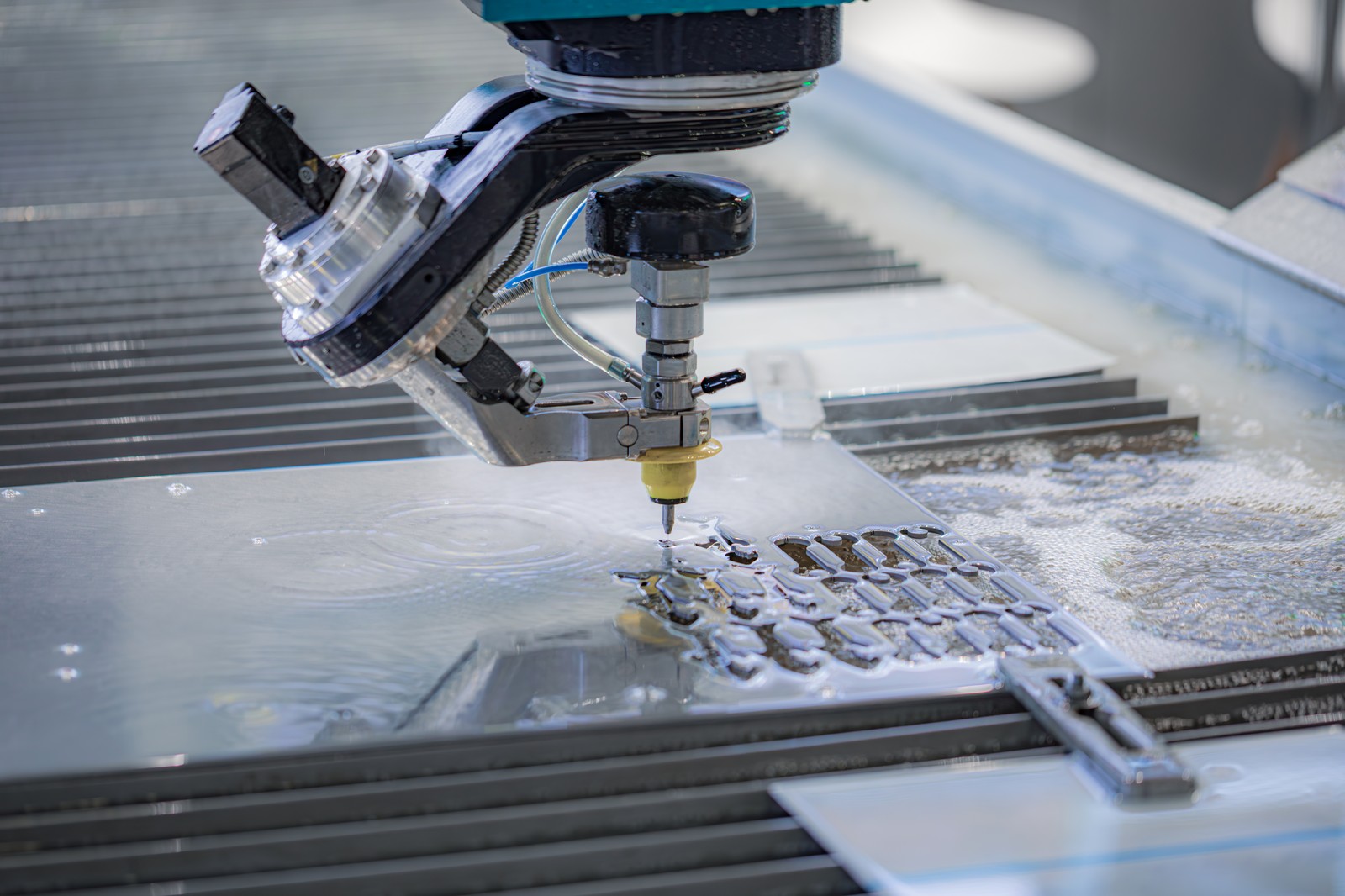
Waterjet cutting takes a different approach entirely. A high-pressure stream of water, sometimes mixed with an abrasive material, cuts through metal without introducing heat.
That absence of heat is one of the process’s biggest advantages. It avoids warping or altering the metal’s structure near the cut edge. Waterjet cutting also handles thicker materials and irregular shapes with more freedom than punching allows. There’s no die to swap out or tooling to design in advance, so a design change mid-project doesn’t require retooling.
This flexibility makes waterjet a good option for prototypes, one-off parts, or jobs where the shape is too complex for a standard die. Projects that call for irregular geometry or a mix of processes often route through our custom metal fabrication capabilities, where cutting, forming, and finishing steps come together under one roof.
Comparing the Two Methods
Both processes cut metal accurately, but they get there differently. Each has trade-offs worth considering before a project starts.
Punching advantages:
- Fast: Cycle times stay quick once tooling is set up
- Cost: Lower cost per part on large production runs
- Consistency: Clean, repeatable hole and shape patterns
- Compatibility: Works well alongside bending and forming steps
Waterjet advantages:
- Heat: No heat-affected zone, so material properties stay intact
- Thickness: Handles thicker stock without extra passes
- Setup: No dedicated tooling needed for custom shapes
- Volume: Better suited to low-volume or one-off parts
Neither method is universally better. A high-volume job with a fixed design almost always favors punching due to the speed and cost savings once tooling is in place. A complex or thick part with a short run, or a part still in the design stage, often benefits from the flexibility waterjet cutting provides.
Material Thickness and Tolerance Considerations
Thickness plays a large role in which process makes sense. Punching works best on thinner-gauge metals, where the punch and die can cleanly shear through the material without excessive tool wear.
Pushing punching equipment beyond its practical thickness range can shorten tool life and affect edge quality. Waterjet cutting doesn’t run into that same limitation. It can cut through thick plate steel and other dense materials with a consistent edge finish from start to finish.
- Hole patterns: Punching holds tight tolerances well on standard hole patterns and repeated shapes
- Profiles: Waterjet holds tight tolerances on intricate or curved profiles
- Finishing: Edge finish from punching may need a secondary deburring step
- Edge quality: Edge finish from waterjet is generally clean without added finishing
Volume is another factor worth noting. Punching becomes more cost-effective as quantities climb, since the upfront tooling cost spreads across more parts. Waterjet pricing stays fairly steady per part regardless of volume. This makes it a practical choice for smaller batches.
Choosing the Process for Your Project
The decision often comes down to answering a few straightforward questions. How thick is the material? How many parts are needed? Does the shape require tight, repeated hole patterns or a more complex outline? Will the part require additional steps, such as bending or forming, afterward?
Answering those questions early saves time and costs down the line. A project team that plans around material thickness and volume from the start avoids costly rework or a mismatched process later in production.
Some projects even use both methods together. Punching handles repeated features, while waterjet handles custom outlines, depending on what the part calls for.
Getting Started on Your Next Fabrication Project
Every part has its own set of requirements. Picking the right cutting process is one of the first decisions that shapes how the rest of a project comes together.
Our team at Gauer Metal Products regularly works through these details with customers. We help match the process to the part rather than forcing a project into a single method. Connect with our team to get started if you’re planning an upcoming run and want to talk through your options.
FAQs
Is punching cheaper than waterjet cutting?
Punching typically costs less per part on large production runs since the tooling investment spreads across many pieces. On small batches, waterjet often works out to be more affordable since it skips tooling costs entirely.
Can waterjet cutting handle thick steel plates?
Yes, waterjet cutting handles thick steel plate without the tool wear concerns that punching can face. The process maintains a consistent edge finish regardless of material depth.
Does punching leave rough edges on metal parts?
Punched parts sometimes need a secondary deburring step to smooth the cut edge. Waterjet cut parts generally come out clean without this extra finishing step.